
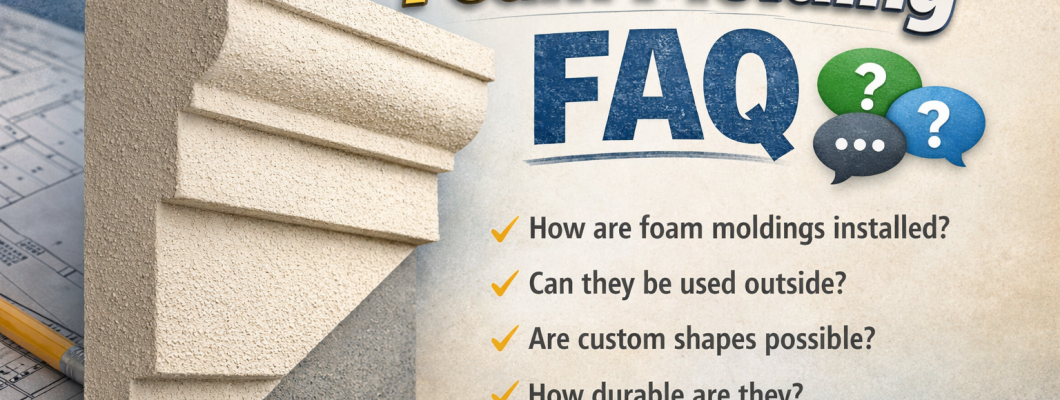
Architectural foam moldings are a proven solution for adding detail, depth, and character to stucco and EIFS projects. If you are using foam trim or moldings for the first time, the questions below cover the most common concerns we hear from homeowners, builders, and contractors.
What exactly are architectural foam moldings?
Architectural foam moldings are decorative building elements made from EPS foam that is CNC cut for precision and consistency. After shaping, the foam is reinforced with fiberglass mesh and coated with a base coat to create a durable surface ready for stucco finishes, paint, or other architectural coatings.
Why choose foam instead of wood, stone, or precast?
Foam moldings are significantly lighter than traditional materials, which reduces labor, shipping costs, and structural load. They are also faster to install, easier to customize, and more cost effective while still delivering a high-end architectural appearance.
Are foam moldings suitable for exterior use?
Yes. Foam moldings are commonly used on exterior stucco and EIFS applications. Proper design details such as drip edges, slopes, reinforcement, and finish coats are essential. When installed and finished correctly, foam moldings perform reliably in exterior environments
How long do foam moldings last?
When installed correctly and protected with appropriate coatings and finishes, foam moldings are designed to last for many years. Longevity depends on proper installation, weather detailing, and maintenance of the exterior finish system.
How are foam moldings installed?
Foam moldings are typically bonded to the substrate using approved foam bonding cement. Because the material is lightweight, installation can usually be handled by one or two installers. Seams between pieces are reinforced with fiberglass mesh tape before applying the finish coat to ensure a seamless appearance.
Do I need mechanical fasteners?
Most standard foam trim and moldings rely on adhesive bonding. However, larger pieces or moldings that project more than 12 inches from the wall surface may require mechanical support or mounting rails for additional strength and long-term stability.
What is a base coat and why is it important?
The base coat is a reinforced coating applied over the foam, usually in combination with fiberglass mesh. It protects the foam, adds impact resistance, and creates a stable surface for the final finish. A proper base coat system is critical to the durability of any foam molding installation
Can foam moldings be painted?
Yes. Once installed and properly coated, foam moldings can be painted or finished to match the surrounding stucco or architectural surface. Always use compatible coatings recommended for exterior applications.
What sizes and shapes are available?
Foam moldings are commonly produced in standard 8-foot lengths, but custom lengths are available. Flat stock trim comes in multiple widths and thicknesses, while decorative profiles such as cornices, columns, arches, quoins, and keystones are typically made to order.
Can foam moldings be curved or arched?
Yes. Foam moldings can be manufactured as curved or arched pieces. For these applications, accurate measurements are critical, including inner and outer radii, overall width, and height. Curved foam pieces are often used around windows, doors, and architectural openings
What minimum thickness is required for foam shapes?
Due to the nature of foam cutting, most profiles should maintain a minimum thickness of about 1/2 inch. Thinner sections may burn through or lose structural integrity during the cutting or installation process.
Can foam be used for signage or lettering?
Yes. Foam can be cut into letters, logos, recessed shapes, or decorative text elements. These are commonly used for building signage, entry features, and branding elements on commercial projects.
Is foam molding a good option for DIY homeowners?
Many DIY homeowners successfully install smaller foam trims and flat stock pieces. Larger or more complex architectural elements are best handled by experienced contractors to ensure proper support, reinforcement, and finishing.
What are common mistakes to avoid?
The most common issues come from incorrect measurements, especially confusing radius with diameter or inches with feet. Measurement errors can result in wasted material or delays, particularly for curved or custom pieces
Can foam moldings help increase curb appeal?
Yes. Foam moldings are one of the most cost-effective ways to dramatically improve curb appeal. Adding trim, sills, bands, or cornices can transform a plain facade into a finished, architectural design.
Where are foam moldings commonly used?
Foam moldings are used on residential homes, apartment buildings, retail centers, offices, and commercial facades. They are commonly applied around windows and doors, at rooflines, corners, entryways, and as decorative accents.